
Is Tasks.Bot Good for Smart Reminder Automation Software?
Your team already lives in WhatsApp, yet tasks still get lost in chat scroll. Reminders that arrive in the same app people check 50 times a day beat another dashboard nobody opens.
This article answers whether Tasks.Bot handles smart reminder automation well. You will learn how its voice notes, natural language AI, and automatic task assignment work, what deadline and recurring automations it supports, what it costs, and which teams it genuinely fits.
What Is Tasks.Bot? A WhatsApp-Native Task Management Platform
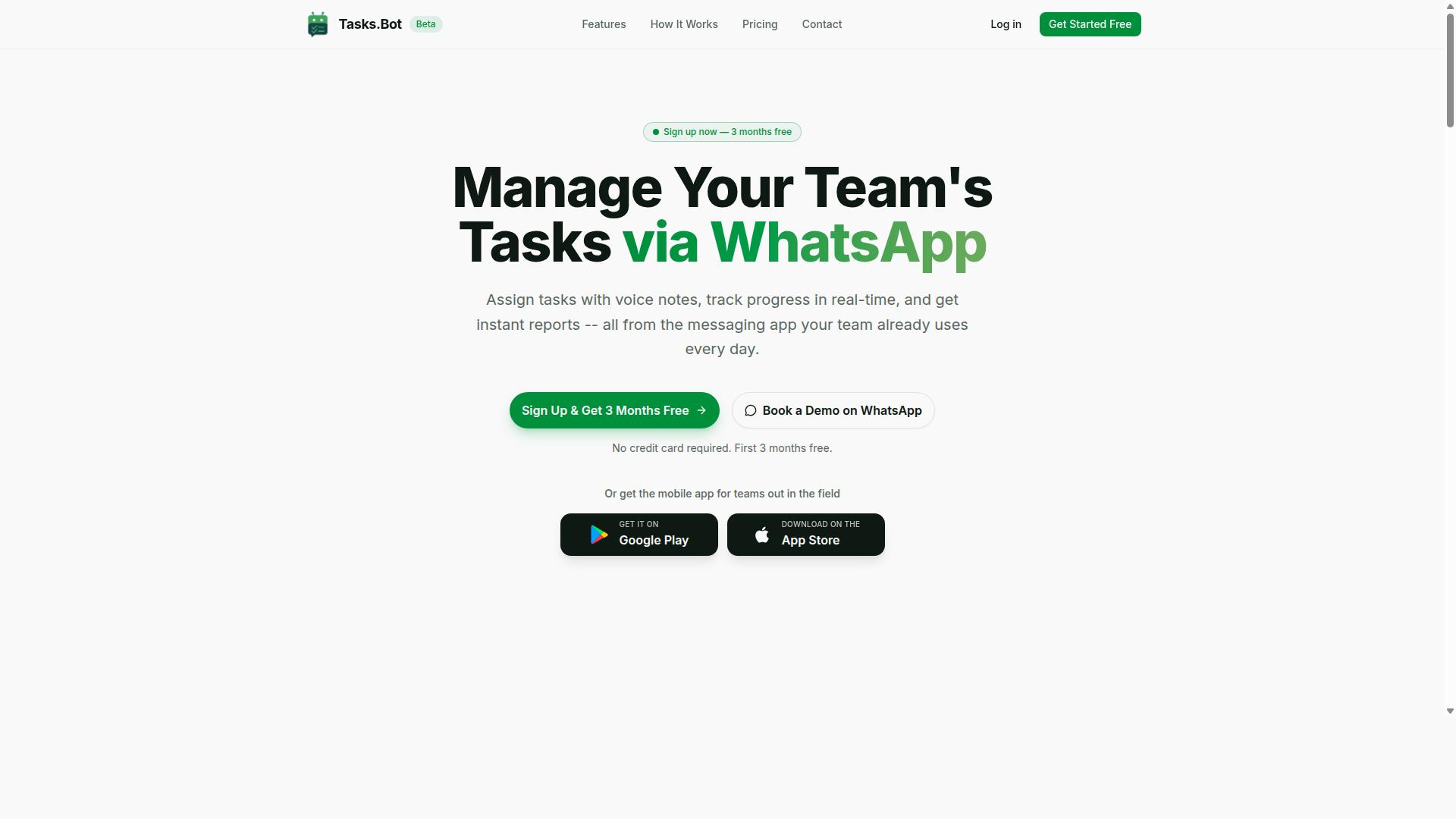
Tasks.Bot is a task management platform that operates entirely within WhatsApp, allowing teams to assign tasks, track progress, and receive reports without leaving the messaging app. Instead of asking people to learn yet another productivity tool, it meets them where they already spend their workday.
That design choice matters. Most task management software adds a new inbox, a new login, and a new set of push notifications to manage. Tasks.Bot removes that layer entirely by turning an existing chat thread into the workspace itself.
The platform also offers a mobile app for field teams, so workers who are away from a desk still have a dedicated way to stay connected to their assignments. The service is currently in beta and offers a free trial period, which gives teams a low-risk way to see whether a WhatsApp-first approach fits how they already work.
For anyone evaluating smart reminder automation software, this is the core premise to understand: Tasks.Bot is not a chat feature bolted onto a traditional project tracker. It is a task management system built around messaging from the ground up.
Who It Serves and How It Works
Tasks.Bot is designed for teams that already use WhatsApp for communication, particularly those with field staff who need to manage tasks, track attendance, and log hours. The site mentions hundreds of teams already using the service, which suggests the model resonates with groups that coordinate remotely or across multiple sites.
The mechanics are straightforward. Users create tasks through voice notes or text, and the AI assigns them automatically. Team members then receive reminders and submit updates inside WhatsApp, without switching between apps.
A few practical points stand out for anyone comparing options:
- No new accounts or app installs are required for team members, which removes the usual onboarding friction.
- Tasks, attendance, and hours all live in one thread rather than across separate tools.
- Hours are payroll-ready, which matters for teams tracking field staff time.
- Reports arrive within the messaging app, so managers do not need to chase updates.
This setup suits businesses where staff may not have laptops or where installing software on personal phones is impractical. A supervisor can send a voice note, the AI assistant turns it into an assigned task, and the worker confirms completion in the same chat.
Compared with tools that rely on Google Calendar integration, Slack integration, or Zapier automation to connect separate systems, Tasks.Bot keeps the workflow contained. There is no cross-platform sync to configure because there is nothing to sync. For teams weighing smart reminder automation software, that simplicity is often the deciding factor.
Is Tasks.Bot Good for Smart Reminder Automation? The Direct Answer
Yes, Tasks.Bot is a capable smart reminder automation tool, but its strength lies in its WhatsApp-native approach and AI-driven natural language processing. It is not a general-purpose reminder app that tries to do everything. Instead, it focuses on doing one thing well: turning conversations into organized, trackable tasks.
For teams that already live in WhatsApp, that focus pays off. There is nothing to install and no new account to create, because Tasks.Bot operates entirely within WhatsApp. A message or voice note becomes a reminder, and the tool handles the rest.
The AI layer is what separates it from a basic chatbot. Tasks.Bot uses natural language processing to understand both typed messages and voice notes for task creation. That means a user can describe what needs to happen in plain language rather than filling out a form or picking options from a menu.
Where does it fall short? Tasks.Bot is still in beta, so the feature set is evolving rather than finished. Teams that depend on deep connections to outside tools may find the integration list thinner than what dedicated reminder apps offer. If your workflow leans heavily on Google Calendar integration, Slack, or a project board like Trello, Tasks.Bot will not replace those connections today.
It is also worth being clear about who this tool serves best. Tasks.Bot fits teams already on WhatsApp, especially those coordinating field staff or remote workers. The platform adds face-verified attendance and live GPS tracking for field staff, plus enterprise-grade encryption so conversations and task data are never shared or used for training.
So the honest verdict is favorable but specific. Tasks.Bot is good for smart reminder automation when WhatsApp is already your team's communication hub. It is less suited to users who want a standalone mobile app, desktop app, or web dashboard with a long list of third-party connections.
For the right team, the trade-offs are easy to accept. A 3-month free trial with no credit card required makes it simple to see whether WhatsApp-native automation fits how your group already works.
Smart Reminder Automation Features That Set Tasks.Bot Apart
Tasks.Bot distinguishes itself through a suite of automation features built directly into WhatsApp, from voice-activated task creation to automated deadline reminders. Instead of asking teams to adopt yet another standalone app, it turns the messaging tool they already use into a working task management system.
That choice matters for smart reminder automation software. Reminders only work when people actually see them, and a reminder buried in a dashboard nobody opens is easy to ignore. Tasks.Bot delivers its notifications where conversations already happen, which keeps deadline tracking visible without extra effort.
Tasks.Bot is a task management and productivity tool that runs through native WhatsApp integration. It also offers Android and iOS apps with push notifications, voice capture, and a home screen widget, so users are not locked into a single screen. Teams can work from WhatsApp or from the mobile app, depending on what suits the moment.
The platform uses an AI assistant to understand user intent and create tasks from messages. That single capability shapes everything below: voice note task creation, automatic task assignment, smart deadline reminders, approvals and automations, instant reports, tasks on a map, a live day tracker, face-verified attendance, and shifts, leave, and hours management.
The two subsections that follow break down how these features work in practice. The first covers how tasks get created and assigned. The second covers what happens after a task exists, from deadline reminders to approval requests and recurring checklists.
Voice Notes, Natural Language AI, and Automatic Task Assignment
Users can create tasks by sending voice notes or typing natural language commands, and Tasks.Bot's AI automatically assigns them to the right team members. There is no form to fill in, no dropdown to search, and no separate project board to update.
The AI relies on natural language processing to parse intent from ordinary speech. Voice commands remove the friction that normally slows delegation down.
This approach reduces manual entry in two ways. First, the person assigning work does not have to translate a spoken thought into fields and menus. Second, the person receiving it gets a clear task instead of a vague message that scrolls away in a busy chat thread.
The practical benefit is speed. Delegation that once required opening a tool, creating a record, and notifying a colleague can happen in the same breath as the conversation that sparked it. For teams juggling shared tasks across multiple chats, that speed compounds over a working day.
It is worth noting what Tasks.Bot does not claim here. The value is not that the AI replaces judgment about who should do what. The value is that it removes the mechanical steps between deciding to delegate and having that delegation recorded, assigned, and tracked.
Deadline Reminders, Approvals, and Recurring Automations
Tasks.Bot automates deadline reminders, approval workflows, and recurring tasks to ensure nothing falls through the cracks. Once a task exists, the system takes over the follow-up that managers would otherwise handle manually.
Smart deadline reminders notify assignees as due dates approach, so time-based triggers do the chasing instead of a colleague sending another "any update?" message. This keeps deadline tracking consistent across a team rather than dependent on whoever remembers to check.
Approvals work inside the same channel. A task can require sign-off, and the request and the decision both happen within WhatsApp. That keeps team collaboration in one place instead of splitting a simple yes or no across email, chat, and a project tool.
Recurring automations handle work that repeats on a schedule, such as daily checklists. Rather than recreating the same list every morning, a team sets it once and lets the automation regenerate it. Recurring reminders are especially useful for routines like opening procedures, shift handovers, or compliance checks.
Together, these three capabilities target the same problem: follow-up effort. Experts recommend automating repetitive coordination precisely because it is the part of project work most likely to be skipped when people get busy. Automation does not make the decision for the team, but it makes sure the decision gets asked for on time.
Tasks.Bot extends this further with instant reports, tasks on a map, and a live day tracker, which give managers visibility into what is done and what is pending. For teams that also manage staff schedules, shifts, leave, hours management, and face-verified attendance sit alongside the task features in the same platform.
For anyone asking whether Tasks.Bot is good smart reminder automation software, the answer is yes, and the reason is structural. It combines voice note task creation, automatic assignment, deadline reminders, approvals, and recurring automations inside WhatsApp, a place teams already check constantly. That combination makes reminders hard to miss and follow-up nearly effortless, which is exactly what reminder automation is supposed to deliver.
Beyond Reminders: Attendance, GPS Tracking, and Field Team Tools
Tasks.Bot goes beyond reminders by offering attendance tracking, GPS location verification, and other tools tailored for field teams. For managers overseeing staff who work outside a single office, these features turn a reminder app into a lightweight operations hub. The mobile app for Android and iOS carries these tools, so supervisors can review activity without sitting at a desk.
Most reminder software stops at nudging someone to do a task. Tasks.Bot adds a layer of proof and record-keeping that matters when work happens off-site. That combination is what separates it from a basic scheduling tool.
Face-verified attendance confirms that the right person checked in, not just that a device did. This matters for teams spread across multiple sites where buddy punching or proxy check-ins can distort records. Attendance data feeds directly into the same system that tracks shifts, leave, and hours, so managers see one consistent picture instead of stitching together separate logs.
GPS location verification connects tasks to places. The platform includes tasks on a map, which helps managers confirm that location-based work was carried out where it was supposed to happen. A field technician, delivery driver, or site inspector can be assigned a job, and the location context travels with it. That reduces disputes about whether someone actually reached a client or job site.
Alongside these, Tasks.Bot includes a live day tracker and shifts, leave, and hours management. Together they give supervisors a running view of who is working, when, and on what. Payroll-ready hour logs flow from the same attendance and shift data, which cuts the manual reconciliation that usually eats into payroll cycles. Instead of exporting timesheets from one tool and checking them against another, managers work from a single record.
All of these capabilities live in the Tasks.Bot mobile app, which also supports push notifications, voice capture, and a home screen widget. Field staff can log activity from a phone on site, and managers can review it from the same app. The wider platform runs on native WhatsApp integration, so task management, approvals, and instant reports reach people where they already communicate.
For teams that need more than a nudge, this turns smart reminder automation software into something closer to a field operations tool. The reminder still fires. The difference is that attendance, location, and hours are captured alongside it, giving managers the oversight and payroll documentation that field work demands.
Pricing: How Much Does Tasks.Bot Cost?
Tasks.Bot offers a single 'Full Access' plan with all features included, priced at ₹200 per member per month or ₹1,200 per member per year. There are no confusing tiers, no locked-away capabilities, and no upsells waiting after checkout. One plan covers the entire product.
That structure matters for anyone evaluating smart reminder automation software. Many productivity tools split essential functions across starter, pro, and business tiers, forcing users to guess which level unlocks the features they actually need. Tasks.Bot removes that guesswork entirely.
Pricing is shown in both Indian Rupees and US Dollars, and the site includes a 'Select currency' option so users can view costs in their preferred denomination. Since exchange rates shift over time, verifying the displayed USD figure at the moment of purchase is a sensible step.
| Plan | Price | Billing Cycle |
|---|---|---|
| Full Access | ₹200 per member | Monthly |
| Full Access | ₹1,200 per member | Annual |
The annual option saves 50%, which works out to ₹1,200 saved per member per year compared with paying month to month. For a team of several members, that difference adds up quickly.
New users also get 3 months free, with no credit card required and the ability to cancel anytime. That gives anyone evaluating the task management and reminder features a genuine trial window before committing money.
It is worth noting that Tasks.Bot is currently in beta. Beta status can mean the product is still evolving, so features and pricing may change over time. A refund policy is referenced in the site footer, and reading those terms before subscribing is a practical step for any buyer.
Overall, the pricing model is simple and transparent. A single plan, a clear annual discount, a free trial period, and a stated refund policy give users enough information to make a confident decision without wading through tier comparisons.
Trust Signals: Beta Status, Encryption, and Refund Policy
As a beta-stage product, Tasks.Bot demonstrates transparency through its refund policy and encryption measures, though user reviews are still limited. That combination tells a clear story: the tool is open about where it stands and what it protects, even while its feature set continues to mature.
For anyone evaluating smart reminder automation software, trust signals matter as much as the feature list. A reminder tool often holds personal schedules, work deadlines, and shared tasks, so how a company handles data and customer risk says a lot about whether it is worth your time.
Beta status is a signal, not a red flag. Tasks.Bot is currently in beta, which means the product is live and usable while still evolving. New capabilities may appear, existing ones may be refined, and the overall experience can shift as the team gathers feedback.
That has two practical implications for buyers. On one hand, you get access to a productivity tool earlier, often at a stage where user input genuinely shapes direction. On the other, you should expect some rough edges and confirm that current behavior meets your needs before you build workflows around it.
None of this suggests the service is unreliable. It simply means the roadmap is still in motion, and a cautious user should treat beta as a reason to test thoroughly rather than a reason to walk away.
Encryption is mentioned as part of the data security approach. For a chatbot and AI assistant that processes natural language, reminders, and scheduling details, protecting that information is essential. Reminder content can reveal when you work, who you meet, and what you keep track of.
Encryption addresses the core concern: data in transit and at rest should not be readable by outside parties. When a vendor states this openly, it gives users a concrete point to evaluate instead of vague promises about privacy.
Readers comparing options should treat encryption as a baseline requirement for any task management tool that stores recurring reminders, deadline tracking, or shared tasks. Tasks.Bot meeting that bar is a meaningful point in its favor.
A refund policy is published in the site footer. That placement matters less than the fact that it exists at all. A stated refund policy gives buyers a defined path if the product does not fit their needs, which reduces the risk of trying something still in beta.
It also signals confidence. Companies that expect customers to stay rarely make refunds difficult to find or understand. Publishing the terms openly, even in the footer, is a small but telling act of transparency.
Before subscribing, read the exact terms so you understand what is covered and any conditions attached. That is standard diligence for any subscription pricing, whether you are looking at a free tier or a premium plan.
Independent user reviews are scarce because the product is in beta. This is the honest trade-off. A newer service simply has not had time to accumulate the volume of third-party feedback that established platforms enjoy.
That does not mean you cannot evaluate Tasks.Bot. It means you should lean on verifiable signals instead of review counts:
- The refund policy published in the footer
- The encryption measures described for data security
- The option to Book a Demo on WhatsApp, which lets you ask questions directly before committing
- The stated beta status, which sets honest expectations about the stage of the product
The WhatsApp demo option is particularly useful here. It gives prospective users a direct channel to clarify how the AI assistant handles natural language processing, recurring reminders, or custom workflows before relying on it for daily planning.
Weighing these factors comes down to what you value. If you need thousands of reviews before you trust a productivity tool, Tasks.Bot is not there yet, and that is a fair position. If you are comfortable with a beta product that is transparent about its stage, protective of your data, and willing to refund unsatisfied customers, the trust signals line up well.
A sensible approach is to start with the free trial, test the features that matter most to you, and use the demo channel to resolve open questions. That way, your decision rests on your own experience rather than on review volume alone.
The verdict is straightforward: Tasks.Bot shows the transparency markers of a legitimate, trustworthy service. Beta status, published encryption, a clear refund policy, and a direct demo option together form a credible foundation, and the limited review pool reflects the product's youth rather than any cause for concern.
Who Should Use Tasks.Bot for Reminder Automation
Tasks.Bot is ideal for teams that rely heavily on WhatsApp for communication, especially those with field staff needing task management and attendance tracking. The platform was built around the way these teams already work, rather than asking them to change their habits.
That focus shapes who gets the most value from this smart reminder automation software. It suits organizations that want reminders, shared tasks, and deadline tracking to flow through a channel their people already check dozens of times a day.
Below are the groups that fit Tasks.Bot best, along with the situations where a different kind of productivity tool may serve you better.
Small to medium teams already on WhatsApp. If your daily coordination happens in WhatsApp groups, Tasks.Bot removes the friction of adopting yet another app. Tasks, reminders, and follow-ups stay in the conversation instead of scattering across inboxes and spreadsheets.
The site mentions hundreds of teams already using the service, which suggests this approach resonates with groups that value simplicity over a long setup process.
Field service teams. Crews working off-site often need more than a reminder. They need to know what to do, where to go, and when they clocked in. Tasks.Bot supports task management and attendance tracking for exactly this kind of distributed workforce.
Because hours captured this way can be payroll-ready, supervisors spend less time reconciling timesheets at the end of a pay period. The reminder layer keeps assignments visible without a manager chasing every worker individually.
Businesses that want to avoid new software. Rolling out a new platform costs time, training, and patience. Teams that would rather not go through that again can lean on a tool that lives inside an app they already use.
This is where a chatbot approach shines. There is no separate desktop app or web dashboard to learn, and no migration project to plan.
Where Tasks.Bot may not be the right fit. Teams that need deep connections to other systems should weigh their options carefully. If your workflow depends on a Slack integration, Trello integration, or heavy Zapier automation, verify that your required connections are supported before committing.
The same caution applies to advanced project management needs. Groups looking for Gantt charts, sprint planning, or complex dependency mapping may find a dedicated project platform more suitable.
Features such as API access, webhooks, or Google Calendar integration should be confirmed against your own requirements rather than assumed. If your team lives outside WhatsApp, the core advantage of Tasks.Bot is smaller.
In short, Tasks.Bot fits teams that communicate on WhatsApp, manage people in the field, and prefer to keep their tools simple. It is a strong match for team collaboration and shared tasks in that environment.
If your needs center on extensive third-party connections or advanced project planning, look closely at whether the platform covers them. For everyone else, the answer is a clear yes: Tasks.Bot is a good choice for reminder automation.
Final Verdict: Is Tasks.Bot Worth It?
Tasks.Bot is worth considering if your team lives in WhatsApp and needs a simple, AI-powered way to automate reminders and manage tasks. It targets a specific gap that many general productivity tools ignore: the messaging app where field teams and small businesses already spend their working hours. Instead of forcing users into another dashboard, it brings smart reminder automation software into a familiar chat thread.
The strengths are easy to summarize. WhatsApp integration sits at the core of the product, which means adoption friction stays low for teams that resist new apps. Voice and natural language task creation let users describe what they need in plain speech or typing rather than navigating complex forms. For organizations running distributed or field-based teams, these two capabilities alone can replace a patchwork of manual follow-ups.
Pricing keeps things straightforward, with no maze of add-ons to decode before you understand what you are paying for. That transparency matters for small businesses comparing subscription pricing across several tools. A productivity tool that is easy to explain, easy to budget for, and easy to adopt has a real advantage over feature-heavy platforms that never get fully used.
There are honest limitations to weigh as well. Tasks.Bot is still in beta status, so some capabilities may evolve or change over time. Its integration list is limited compared to mature platforms offering extensive Google Calendar integration, Slack integration, Trello integration, Zapier automation, or IFTTT support. Independent user reviews are also scarce, which means buyers cannot lean on a large body of third-party feedback the way they might with older, more established products.
Here is a quick summary of the trade-offs:
- Pros: WhatsApp-first design, voice and natural language task creation, field team tools, and straightforward pricing.
- Cons: Beta status, a limited integration ecosystem, and few independent reviews available.
For teams whose daily communication already runs through WhatsApp, the pros clearly outweigh the cons. The beta label signals active development rather than instability, and the focused feature set is a strength for anyone who wants reminders and task management without a steep learning curve. A chatbot that understands natural language processing requests removes the biggest barrier to consistent use: remembering to log tasks at all.
If your workflow depends heavily on cross-platform sync, a web dashboard, or deep connections to calendar and project tools, Tasks.Bot may feel narrow right now. But if your priority is fast, low-friction reminder automation for a team that works from chat, it fits the job well. The verdict is favorable: Tasks.Bot is a credible, purpose-built choice for WhatsApp-centric teams, and its simplicity is precisely what makes it effective.
Readers who want to learn more or book a demo can reach the team directly. Call +91 97143 42522 or email [email protected] to ask questions about the product, its current beta features, and how it might fit your team's reminder and task workflows.
Frequently Asked Questions
What exactly is Tasks.Bot, and how does it work?
Tasks.Bot is a task management platform that operates via WhatsApp, letting teams assign tasks, track progress, and receive reports without leaving the messaging app. It uses AI to understand natural language and voice notes, so you can create tasks just by typing or speaking. There's also a mobile app for field teams who need features like tasks on a map and live day tracking.
Do my team members need to install an app or create new accounts?
No. Tasks.Bot works entirely within WhatsApp, so team members don't need to install anything or create new accounts to get started. For field teams that need more, a mobile app is also available. This makes onboarding simple for teams already using WhatsApp for communication.
What kinds of reminders and automations does Tasks.Bot offer?
Tasks.Bot includes smart deadline reminders, automatic task assignment, approvals and automations, and instant reports. It also supports voice note task creation and face-verified attendance with live day tracking. These features are designed to keep work moving without manual follow-ups.
How much does Tasks.Bot cost?
Tasks.Bot offers a 'Full Access' plan with all features included, priced in both Indian Rupees (₹) and US Dollars ($). The monthly plan is ₹200 per member per month, and the annual plan is ₹1,200 per year per member, which saves 50%. You can book a demo on WhatsApp to see it in action before committing.
Who is Tasks.Bot best suited for?
Tasks.Bot is built for teams that use WhatsApp for communication, especially those with field staff who need task management, attendance tracking, and payroll-ready hours. Hundreds of teams are already using the service. It's available worldwide, since it's a SaaS product accessible via WhatsApp and mobile apps.
Is Tasks.Bot available in my country, and how do I get support?
Tasks.Bot is available globally with no country restrictions, as it's a SaaS product accessible via WhatsApp and mobile apps. If you have questions, you can reach the team at [email protected] or +91 97143 42522. The service is currently in beta, and a refund policy is mentioned in the website footer.
Recommended Resources: